 |
 |
 |
 |




In
the October 2015 edition of the BBC-published magazine FOCUS there was an
article written by Zoe Cormier about the scientifically-proved benefits of
music, which not only proved to be extremely interesting reading, but also
backed up what had been my gut feeling about the therapeutic value of
music (specifically, from my point of view, group drumming) for years. My
brief summary of the key points follows, but the full article is
reproduced below (along with scans of the original pages on the left -
click an image for the large version). Please read the full article - my
summary is hopelessly inadequate!
- pStan
Studies have shown that music can improve health in a number of ways. The social interaction of playing music in a group makes us feel good, but it goes further than that. Music can anatomically, chemically and beneficially alter your brain, as follows:
- The outer layer of the brain thickens with musical training.
- The nerve fibres that connect the left and right hemispheres of the brain to each other thicken.
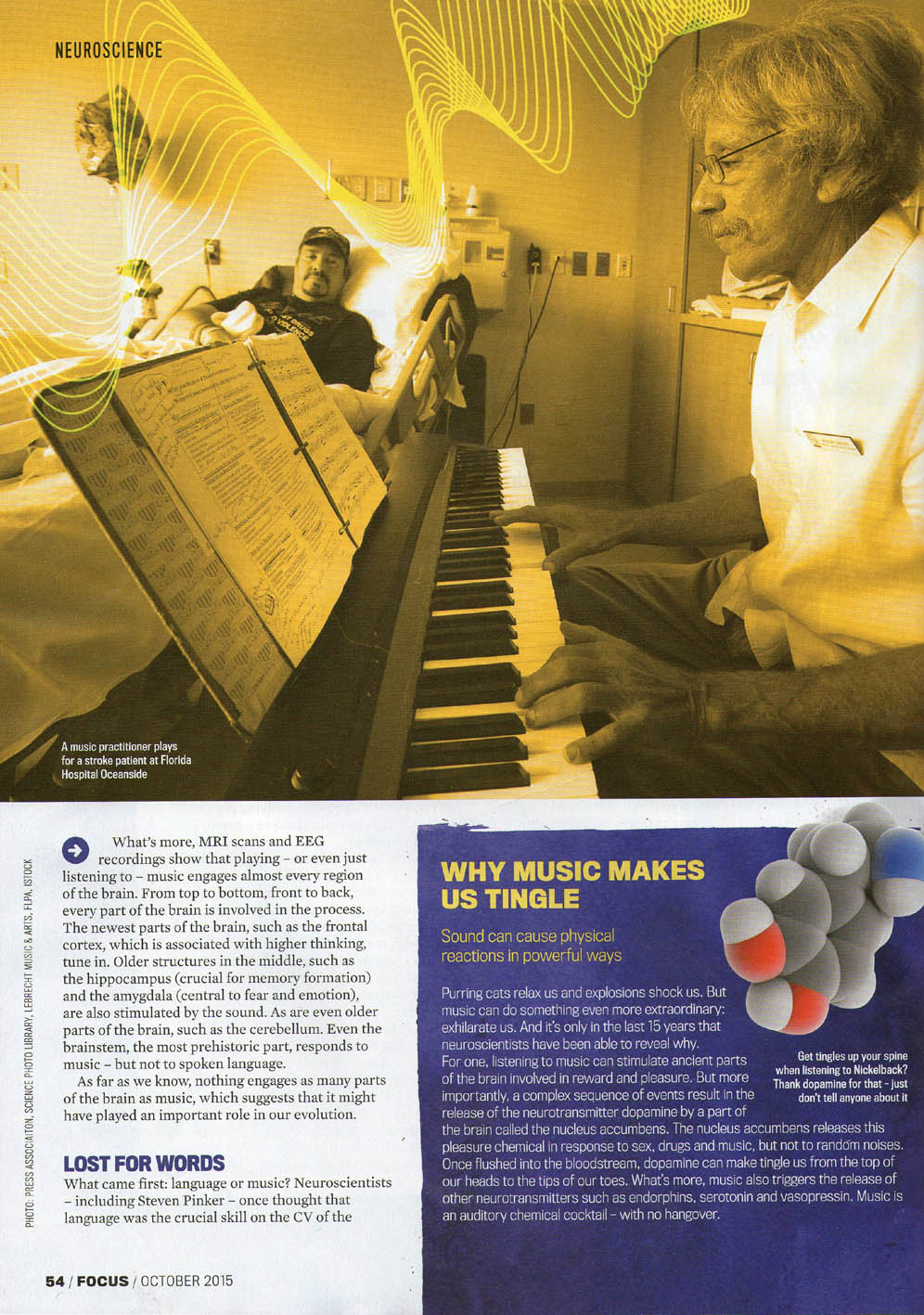
- MRI scans and EEG recordings show that playing, or even just listening to, music engages almost every region of the brain - as far as we know, nothing engages as many parts of the brain as music, which suggests that it might have played an important role in our evolution.
Music is used
in assisting stroke victims to regain speech - when a stroke damages areas
in the left hemisphere of the brain that are crucial for language, musical
training can cause regions on the undamaged right hemisphere to take on
the task of producing speech instead.
Music can also be beneficial for people with autism, in
helping them interact with others.
Music, specifically rhythm, can assist sufferers of
Parkinson's to improve their walking, as well as motor control and their
speech.
Music can alleviate symptoms like depression and anxiety in
Alzheimer's sufferers - even when people with advanced-stage dementia
can't remember the names of their children, they can recall lyrics from
the songs of their childhood, and by singing and dancing they can engage
socially.
Most importantly, music can stimulate ancient parts of the
brain involved in reward and pleasure, releasing dopamine (the body's
natural pleasure chemical) as well as other chemicals such as endorphins,
serotonin and vasopressin. "Music is an auditory chemical cocktail -
with no hangover"!
(As a follow-up to this, an article on the Royal College of Music's website from March 2016 says, "Research has found that drumming has a positive impact on mental health, with a 10-week programme of group drumming reducing depression by as much as 38% and anxiety by 20%". To read the full article click here.)
Full article, reprinted from FOCUS, October 2015
Music moves us to tears and drives us to dance. But as well as affecting our moods, it can also have a positive impact on our health. In fact, the more we learn about the power of music, the more applications we discover for it, as Zoe Cormier explains . . .
MUSIC IS
MEDICINAL. You might expect a statement like this to come from someone in
a drumming circle, a chanting crystal healer or sleazy record-label
executive. But the idea that music can be used to heal the mind is
increasingly grounded in scientific evidence - not theory.
Recent studies show how people coping with Parkinson's can
learn to walk more easily when rhythms assist their gait. Other research
suggests autistic children find social interactions become easier when
accompanied by music, and that less anaesthetic is required when music is
played to spinal surgery patients. Perhaps most astoundingly, premature
babies gain weight quicker when they can hear music.
Scientific
studies - ranging from investigations of the brain at a cellular level, to
psychiatric assessments of schizophrenics, to linguistic scores in stroke
patients - are all leading to the same conclusion: music isn't just a form
of entertainment, it is evolutionarily significant. And the more we learn
about the impact of music on the brain, the more we understand how it can
be employed as a therapeutic intervention.
"I
originally trained as a music therapist but when I went into practice 15
years ago, I found that so little formal research had been done on how or
why it works," says Prof Christian Gold of the Grieg Academy
Department of Music at the University of Bergen in Norway. Gold studies
how music therapy can help people with a wide variety of conditions,
ranging from learning disabilities to schizophrenia and dementia. "I
had planned to go back into clinical practice after spending a few years
in research but 15 years later, I'm still researching. There's just so
much to learn."
Perhaps the most familiar notion of the power of music is the
claim that listening to Mozart is good for your brain. But that only tells
half the story. Listening to classical music (or any kind of music, for
that matter) does have quantifiable impacts on aspects of cognition, such
as visual puzzle solving. However, everything you do - solving puzzles,
playing sports, painting landscapes - has an impact on your brain.
But nothing seems to anatomically, chemically and
beneficially alter your brain the way music can. The grey matter, which is
the outer layer of the brain that contains the synapses - the ends of the
neurones where signals are relayed - thickens with musical training.
Furthermore, the cerebellum, which is the wrinkly bulb at the back of the
brain that's crucial for balance, movement and motor control, is bigger in
pianists.
Neuroscientists have documented many other anatomical changes
that come with musical experience but the most profound is thought to be
the fact that the corpus callosum - a band of nerve fibres that connect
the left and right hemispheres to each other - thickens. No-one is quite
sure what helping the two sides of the brain to communicate with each
other accomplishes, but 20 years after this discovery, nobody has found
anything else that does this. What's more, MRI scans and EEG recordings
show that playing - or even just listening to - music engages almost every
region of the brain. From top to bottom, front to back, every part of the
brain is involved in the process. The newest parts of the brain, such as
the frontal cortex, which is associated with higher thinking, tune in.
Older structures in the middle, such as the hippocampus (crucial for
memory formation) and the amygdala (central to fear and emotion), are also
stimulated by the sound. As are even older parts of the brain, such as the
cerebellum. Even the brainstem, the most prehistoric part, responds to
music - but not to spoken language.
As far as we know, nothing engages as many parts of the brain
as music, which suggests that it might have played an important role in
our evolution.
What
came first: language or music? Neuroscientists - including Steven Pinker -
once thought that language was the crucial skill on the CV of the human
brain and the characteristic that set us apart from other animals. He
called music 'auditory cheesecake' - meaning that we like structured
noises because they exploit the same networks in our brains that are built
to process grammar, prosody and other speech patterns.
But not only does music engage parts of the brain that are
not stimulated by language, it is possible to be musical and completely
non-verbal. Aphasia - the loss of speech comprehension or production -
frequently occurs following a stroke and can leave many people unable to
speak and thus feeling isolated and depressed. Yet often those who can't
speak can still appreciate and create music. The most famous example of
this is the Russian composer Vissarion Shebalin (1902-1963) who developed
aphasia after a series of strokes. He couldn't speak, yet he could still
craft entire symphonies, completing his fifth and final one just three
months before his death.
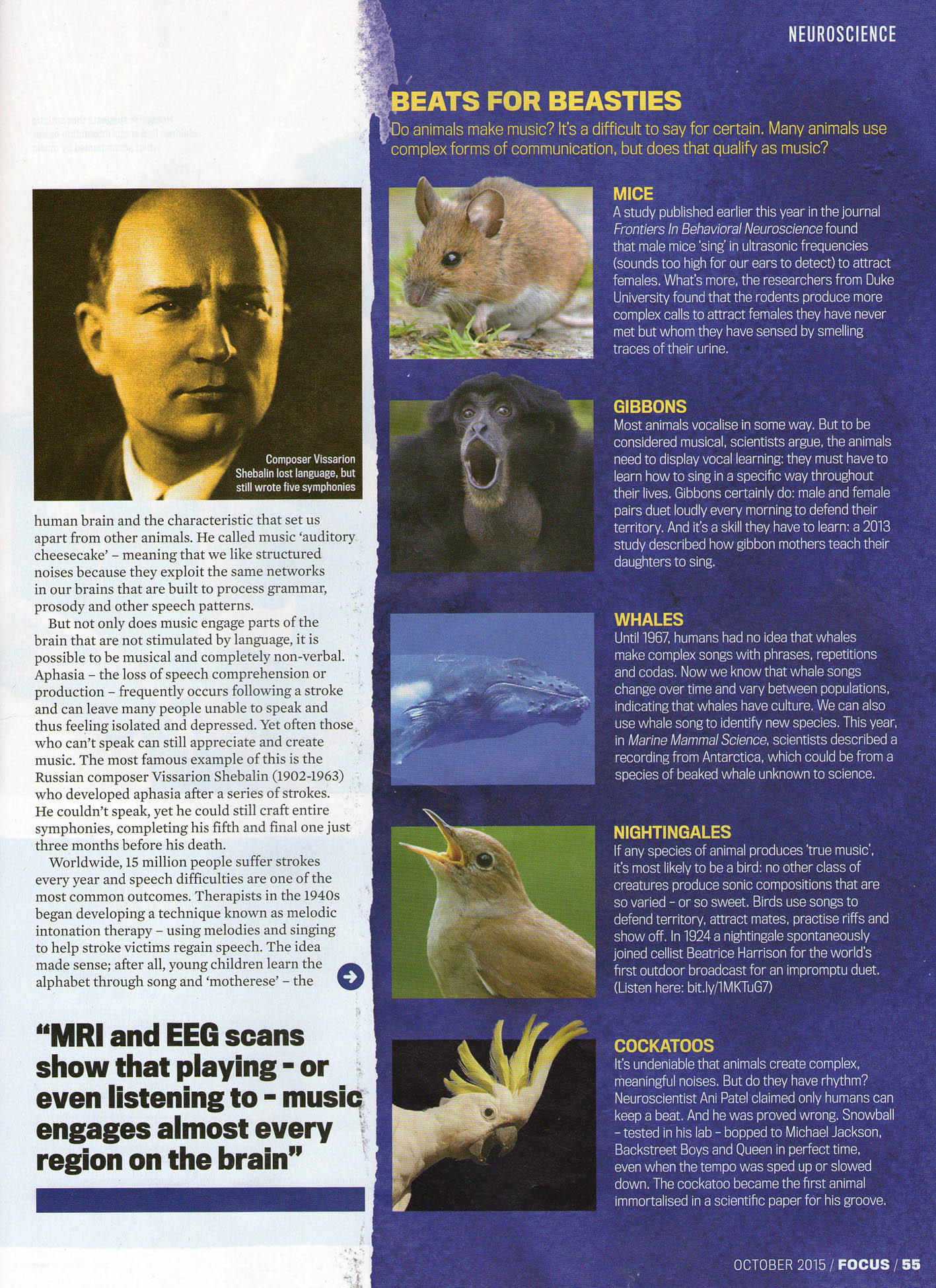
Worldwide,
15 million people suffer strokes every year and speech difficulties are
one of the most common outcomes. Therapists in the 1940s began developing
a technique known as melodic intonation therapy - using melodies and
singing to help stroke victims regain speech. The idea made sense; after
all, young children learn the alphabet through song and 'motherese' - the
sing-song language that parents coo to their babies that is found in every
culture on Earth. Neuroscientists theorised in the 1970s that when a
stroke damages areas in the left hemisphere of the brain that are crucial
for language - in particular, Broca's area - musical training can cause
regions on the undamaged right hemisphere to take on the task of producing
speech instead.
Since then countless studies have documented how music can
aid speech recovery. The highest profile example of this is probably US
congresswoman Gabrielle Giffords. She was shot in the head in 2011 but
survived the attempted assassination. She credits music therapy for
helping her regain the ability to read, write and speak.
"Although it's still an open question over what aspects
of music are important - rhythmic or melodic - there is growing evidence
that melodic intonation therapy can help people with aphasia," says
Dr Teppo Sarkamo of the University of Helsinki. Through examining MRI
scans of stroke patients he has shown not only that music aids in language
recovery, but actually induces visible changes in a variety of brain
structures after just six months of treatment.
In 2008, Sarkamo found that of 54 stroke patients, those
given musical recordings improved in their linguistic capacities to a
greater degree than patients given audio books. Music aided language
recovery better than language itself.
"One of the things that makes music so interesting is
that it's pleasant but at the same time cognitively demanding," says
Sarkamo. "This is one of the few therapeutic interventions we have
that is both soothing as well as challenging."
Music
can also be used to help patients who have never been able to speak in the
first place, such as people with Rett syndrome. "Because they don't
tend to speak at all, we struggle to understand what they may be thinking
or feeling," says Gold, whose own research has measured how music
stimulates the brainstems of people with Rett syndrome. "This seems
to be an important indicator of the effects that music therapy may be
having on them - relaxation or excitement."
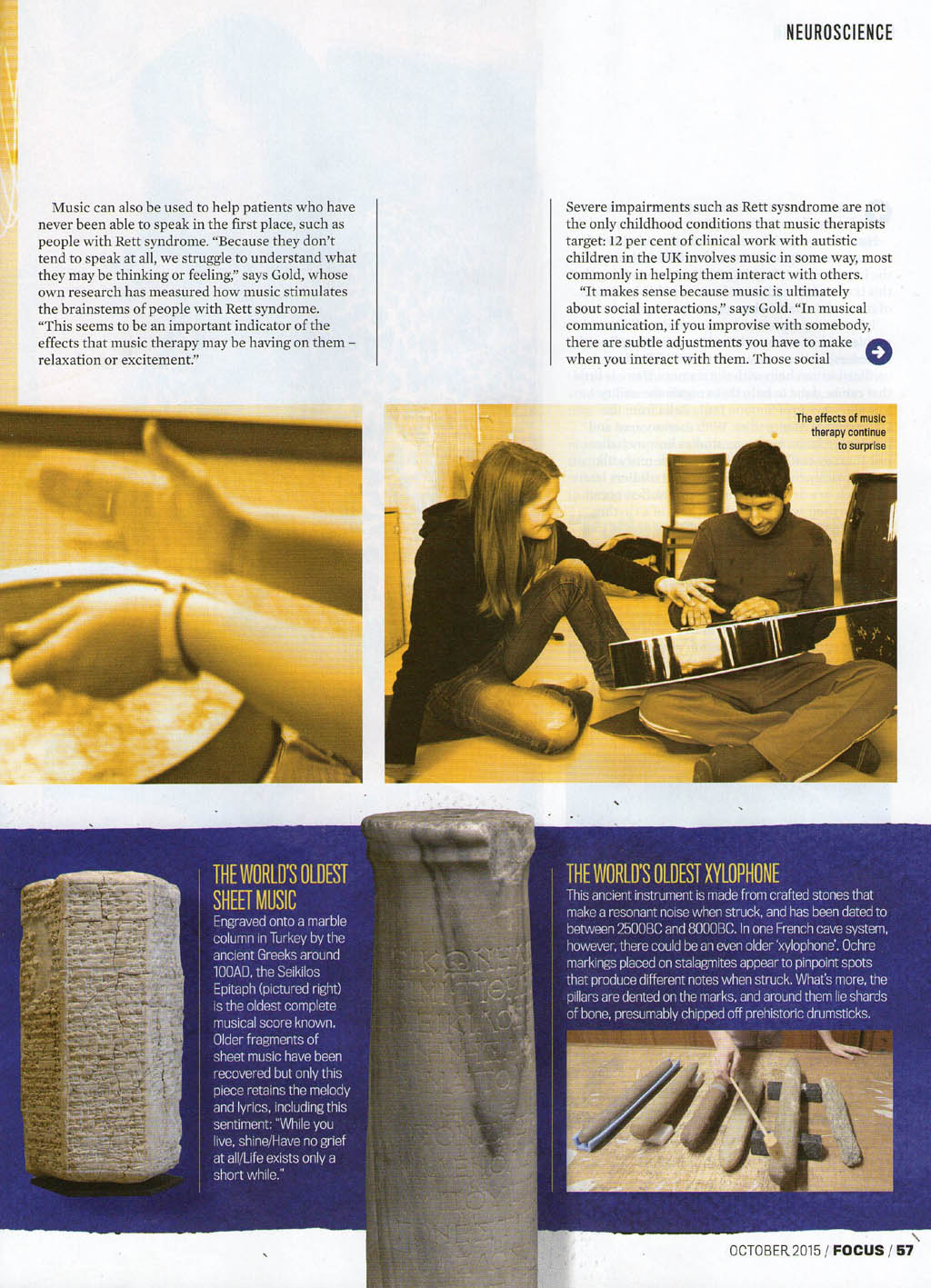
Severe impairments such as Rett sysndrome are not the only
childhood conditions that music therapists target: 12 per cent of clinical
work with autistic children in the UK involves music in some way, most
commonly in helping them interact with others.
"It makes sense because music is ultimately about social
interactions," says Gold. "In musical communication, if you
improvise with somebody, there are subtle adjustments you have to make
when you interact with them. Those social exchanges are the most important
part of most forms of music therapy." Humans are social creatures
that require social contact. Few experiences can be more isolating than
the impairments of ageing, so it's not surprising that this is one of the
oldest and most established areas of research in music therapy.
Take, for example, the tremors and mobility problems that
come with Parkinson's: "People with disorders that cause tremors tend
to fall. Though medication can help with the tremors, there is little that
can be done to help them regain the ability to walk," says Prof
Simone Dalla Bella from the University of Montpellier. With metronomes and
percussive instruments, he studies how melodic gait therapy can help
Parkinson's sufferers walk more steadily. Similar to the way that soldiers
learn to march to a drumbeat, Parkinson's sufferers can improve their
walking with the help of a rhythm.
"The fascinating thing about this therapy is that the
benefits are not confined to gait - we also see improvements in things
like motor control," says Dalla Bella. "Patients who are given
auditory cue training, for example, can greatly improve in their
perception of and ability to produce speech."
The mechanism by which music helps Parkinson's patients
appears to lie in a region of the brain called the nucleus accumbens. This
is the same region that releases dopamine - the neurotransmitter
associated with pleasure - in response to chemical stimulants like drugs,
or physical stimulants like sex.
Parkinson's is characterised by an impairment of the
connections between a cluster of brain structures called the basal ganglia
and other regions due to a lack of dopamine. So it makes sense, says Dalla
Bella, that if music can trigger the release of dopamine in that region,
it would be helpful.
Of
all the afflictions of old age, none could be more isolating than
Alzheimer's: memories are left behind, loved ones are forgotten and whole
identities are gradually lost. More than 25 million people in the UK are
affected, by knowing somebody who has dementia.
"We don't have a cure for Alzheimer's and there is no
cure on the horizon: we need to work on ways to make the sufferers' lives,
and the lives of their carers, easier," says psychologist Dr Victoria
Williamson of the University of Sheffield, author of You Are The Music.
"Music is not a pill or a vitamin or a cure, but it can provide
powerful support, alleviating real symptoms like depression and anxiety.
There is no reason not to invest in providing music to as many people
living in care homes as possible."
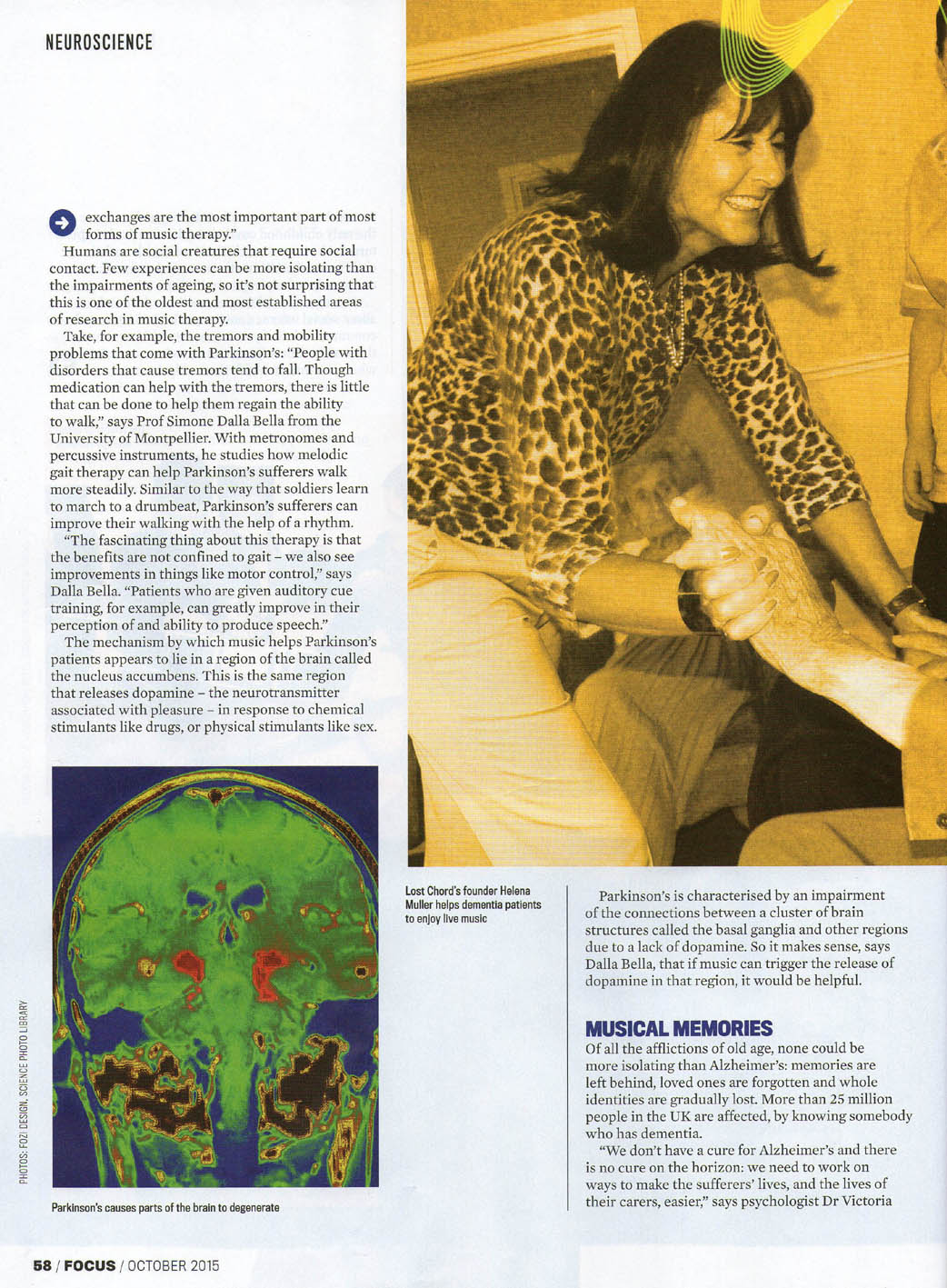
After spending many years in the lab studying musical memory,
Williamson began working with the charity Lost Chord. Lost Chord was set
up in 1999 by Helena Muller to provide live music in residential care
homes for people with dementia. "People regularly describe the Lost
Chord memory cafes as their lifeline. People can revert back to being a
couple again rather than carer and person with dementia. The benefits
gained by the people with dementia is immeasurable. To observe people who
are withdrawn and isolated come out of their shell and engage by singing
and dancing is tangible, powerful and emotional for all to see," says
the Alzheimer's Society.
"The choir at the Lost Chord memory cafe is one of the
few things that makes him smile," says Marion Jones, whose husband
has severe Alzheimer's.
The deep hold that music can have in our memories is perhaps
best exemplified at events like the Lost Chord memory cafes. Even when
people with advanced-stage dementia can't remember the names of their
children, they can recall lyrics from the songs of their childhood. Recent
neurological studies have verified and scrutinised this, with important
findings.
"It is important that we work to provide live music to
people in care homes, and not simply give them iPods to sedate them,"
says Williamson. "Why would an isolating condition be alleviated by
an isolating device?"
This
brings us back to what music, ultimately, is: a form of social navigation
via sound. As it involves so many ancient brain regions, and can be used
in so many therapeutic ways, is music something we are 'hardwired' for?
"I used to think so - but the more I learn about music,
the more I think it's not something we inherited: I think it is an
invention. Yes, our brains are pre-programmed to be able to produce music.
But music didn't make us - we made it," says Williamson. "We
began making music because it fulfilled so many useful purposes:
communication, social bonding, teamwork, sexual attraction. It's a ball we
just can't put down. This is the best invention we ever came up
with."
- ZOE CORMIER ( a freelance science writer and the author of Sex, Drugs & Rock 'N' Roll: The Science Of Hedonism.)
WHY
MUSIC MAKES US TINGLE
Sound can cause physical reactions in powerful ways. Purring
cats relax us and explosions shock us. But music can do something even
more extraordinary: exhilarate us. And it's only in the last 15 years that
neuroscientists have been able to reveal why. For one, listening to music
can stimulate ancient parts of the brain involved in reward and pleasure.
But more importantly, a complex sequence of events result in the release
of the neurotransmitter dopamine by a part of the brain called the nucleus
accumbens. The nucleus accumbens releases this pleasure chemical in
response to sex, drugs and music, but not to random noises. Once flushed
into the bloodstream, dopamine can make tingle us from the top of our
heads to the tips of our toes. What's more, music also triggers the
release of other neurotransmitters such as endorphins, serotonin and
vasopressin. Music is an auditory chemical cocktail - with no hangover.